Americans For Prosperity, a political advocacy network funded a the Koch brothers, recently launched a campaign to support President Trump’s efforts to roll back fuel efficiency and automobile emissions standards.
Through social media feeds of the many AFP state chapters, the group is promoting a petition to “Repeal Costly Obama-era Fuel Standards.”
According to its 2017 annual report, Life: Powered was originally TPPF’s “Fueling Freedom” project, which launched in 2015 “to combat the Obama-era Clean Power Plan.”
The annual report explains how Life: Powered will expand on the scope of the original “Fueling Freedom project:
“In 2018, we’ll be taking the project to a new level, expanding it to cover every aspect of the policies that promote abundant, reliable, and affordable energy to power modern life.”
Though there isn’t yet much public presence for the project, TPPF is currently hiring a Project Coordinator and Policy Analyst for “Life: Powered.” The organization also has a “Life:Powered” playlist on Youtube.
Colorado Governor John Hickenlooper announced Tuesday that his state would join 13 states and the District of Columbia in adopting California’s clean car emissions standards. “Colorado has a choice,” Gov. Hickenlooper said in a statement. “This executive order calls for the state to adopt air quality standards that will protect our quality of life in Colorado. Low emissions vehicles are increasingly popular with consumers and are better for our air. Every move we make to safeguard our environment is a move in the right direction.” Continue reading “Colorado Adopts California Clean Car Standards in Another Blow to Trump, Kochs”
A coalition of conservative groups, many with close ties to the Koch brothers, are calling for Environmental Protection Agency (EPA) Administrator Scott Pruitt to strip California of its right to set stricter greenhouse gas limits for personal vehicles.
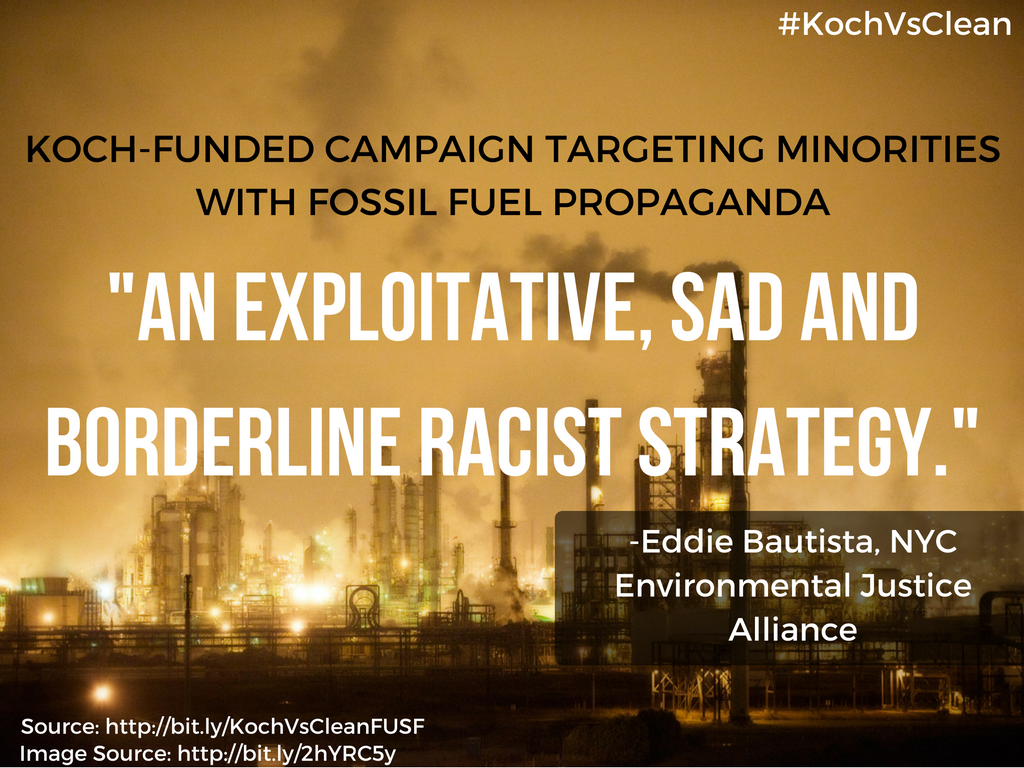
Back in August at the Red State Gathering in Denver, Fueling U.S. Forward President Charles Drevna revealed that one of the campaign’s major strategies would involve targeting minority communities. A remarkable article just published by The New York Times reveals how the group is enacting this strategy, hosting and supporting events in minority communities while promoting the “importance of domestic oil and natural gas to making people’s lives better,” as Drevna put it.
The American Fuel & Petrochemical Manufacturers (AFPM) is a national trade association representing 98 percent of oil refining capacity in the United States.The AFPM was formerly known as the National Petrochemical & Refiners Association, before rebranding in 2012. Both James Mahoney and Charles Drevna have served in leadership capacities at the association. Mahoney twice served as chairman of the board of the organization, once while it was the NPRA and then again during the group’s rebranding in 2012. Drevna served as President of the AFPM.
The AFPM has a long history of taking positions that promote oil interests and undercut any potential competition to petroleum products, such as: opposing renewable fuel standards, supporting increasing domestic oil and gas production on public and private lands, and arguing that the EPA has no authority to regulate greenhouse gam emissions.
In late 2018, AFPM was linked to a shadowy campaign aimed at rolling back fuel efficiency standards. The website of a front group, Energy4US, was registered by an AFPM staffer, and the group is listed as a member of the coalition.
According to old WHOIS website registration information, Energy4US was formerly registered to Victor Adams, head of websites and marketing at the American Fuel & Petrochemical Manufacturers (AFPM). Other deviations of energy4us.com and .org were also registered to Victor Adams.Recently, the group has released studies that undermine oil-by-rail safety measures by using testing methods that, the Wall Street Journal reports, “may understate the explosive risk of the crude.”
AFPM also recently joined the U.S. Chamber of Commerce, the National Association of Manufacturers, and others in filing a petition for review to block the Environmental Protection Agency’s Clean Power Plan.
Electric vehicles are a clear threat to gasoline, the biggest product of oil refineries, and have come in the crosshairs of the AFPM. In 2012, then-President Charles Drevna (now a senior fellow at the Institute for Energy Research), testified to Congress:
As Congress and the Administration seek ways to increase our energy security, economic security, and national security, AFPM urges policymakers to weigh the full spectrum of trade-offs. While weaning the U.S. off oil is a good talking point, artificially forcing the market to adopt expensive new technologies that rely on the fair trade practices of China could bring a new set of challenges. In the meantime, the U.S. can instead develop its own abundant supply of energy, which can increase our energy, economic and national security. The U.S. can do so without subsidies or mandates, all our industry needs is the room to do it. As we look to diversify our energy sources, we must not turn our back on petroleum-derived fuels that we will continue to depend upon for decades to come. To do so would simply disadvantage the consumer, harm our national economy and erode our energy security.”
Working with Big Corn to Defeat EVs
While AFPM has long opposed the Renewable Fuel Standard and the integration of biofuels into gasoline blends, the two industries are working together to lobby against EV incentives.
In February 2017, while on a panel with the head of the Renewable Fuels Association, Chet Thompson, president of AFPM said, “(We) think we should be working to promote the longevity of the internal combustion engine.” Thompson added that AFPM welcomes RFA and others pointing out what he described as “inequities” in the support the electric vehicle industry receives.
The American Energy Alliance (AEA) is the “advocacy arm” of the Institute for Energy Research, and describes itself as a “not-for-profit organization that engages in grassroots public policy advocacy and debate concerning energy and environmental policies.”